
Trump’s FDR Strategy
The Interwar Era

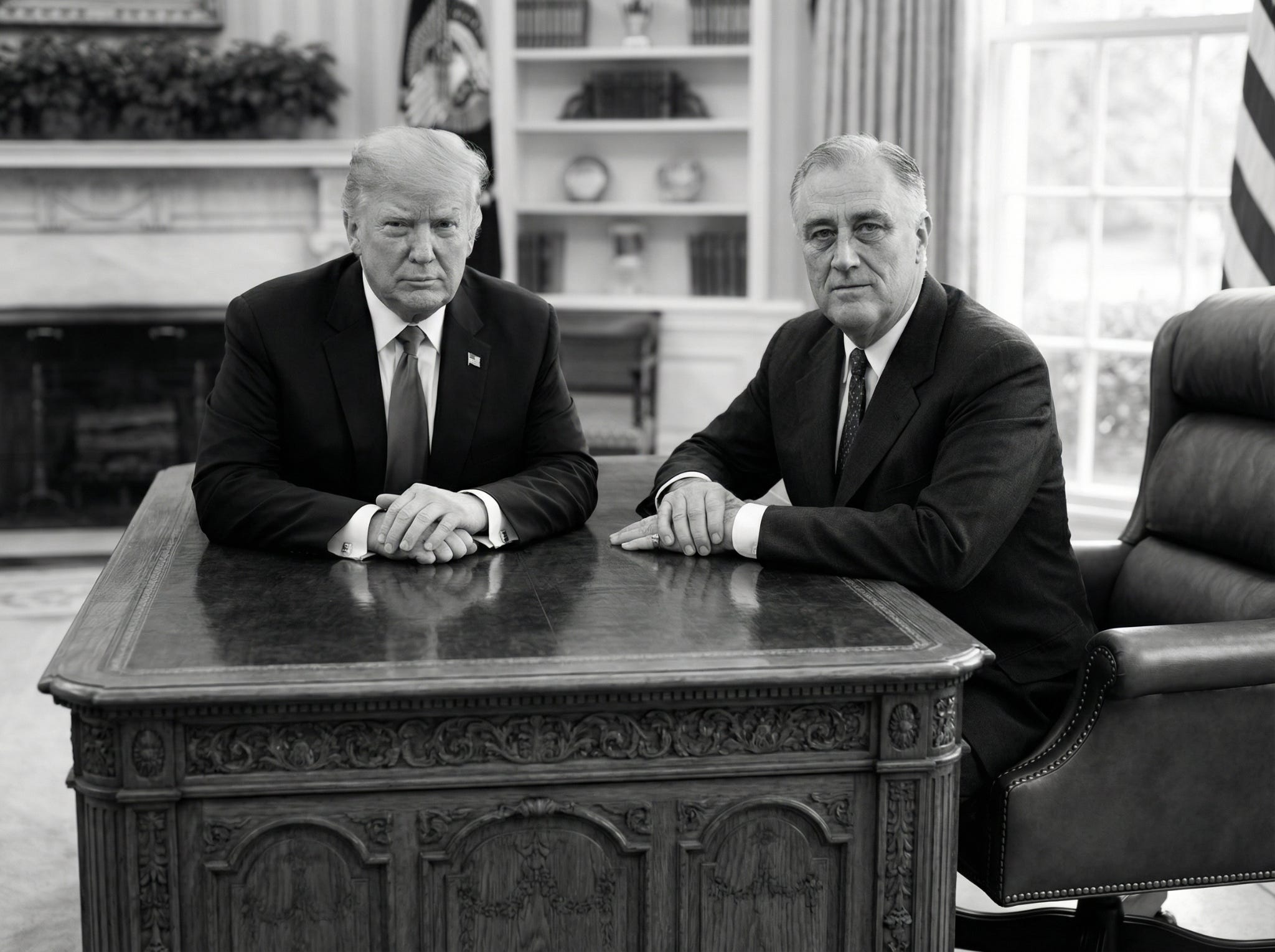
The 2025 National Security Strategy looks very similar to FDR’s strategy in the 1930s. The US once again finds itself in a world with totalitarianism on the rise, challenges to international trade, an American industrial base in need of revitalization, and voter malaise.
The American Voter
American strategy often reflects the beliefs of a significant American voting bloc, and this NSS is no different. The beliefs that American voters hold about foreign policy in the 2020s are very similar to those of the 1930s in some respects. American voters are questioning the value of foreign intervention.
During the ‘30s, there was significant pessimism about the US role in WWI. In the short 1917-1918 window, the US would suffer over 100k war dead, when the benefits were unclear to voters at the time.
During the Great War, the US had to fight to retain control over its own military forces, lest they be redistributed as replacements to French and British officers. Paris and London would only begrudgingly accept the US at the table for wartime planning and post-war negotiations.
Wilson’s League of Nations experiment would also fail. By 1936, it was clear that the Treaty of Versailles was not working as intended when Germany reoccupied the Rhineland.
Smedley D. Butler, the retired Marine Corps General and two-time Medal of Honor recipient, would become a spokesman for virulent left-wing anti-war protestors. He would write his influential 1935 speech, “War is a Racket,” which became a best-selling book. One of the solutions General Butler offered was to make it illegal for the US to deploy the Navy or Army.
These were the times of the Lost Generation that had come of age during WWI. As F. Scott Fitzgerald wrote in This Side of Paradise, the Lost Generation was “a generation grown up to find all Gods dead, all wars fought, all faiths in man shaken.” Sound familiar?
This paradigm had a profound influence on younger generations. During the 1935 student protests, millions of American students would hold massive anti-war demonstrations, though the US was not at war. The students marched against ROTC programs, their own university presidents, and pledged never to support conscription for another foreign war. These protests would be a feature of campus life for years.
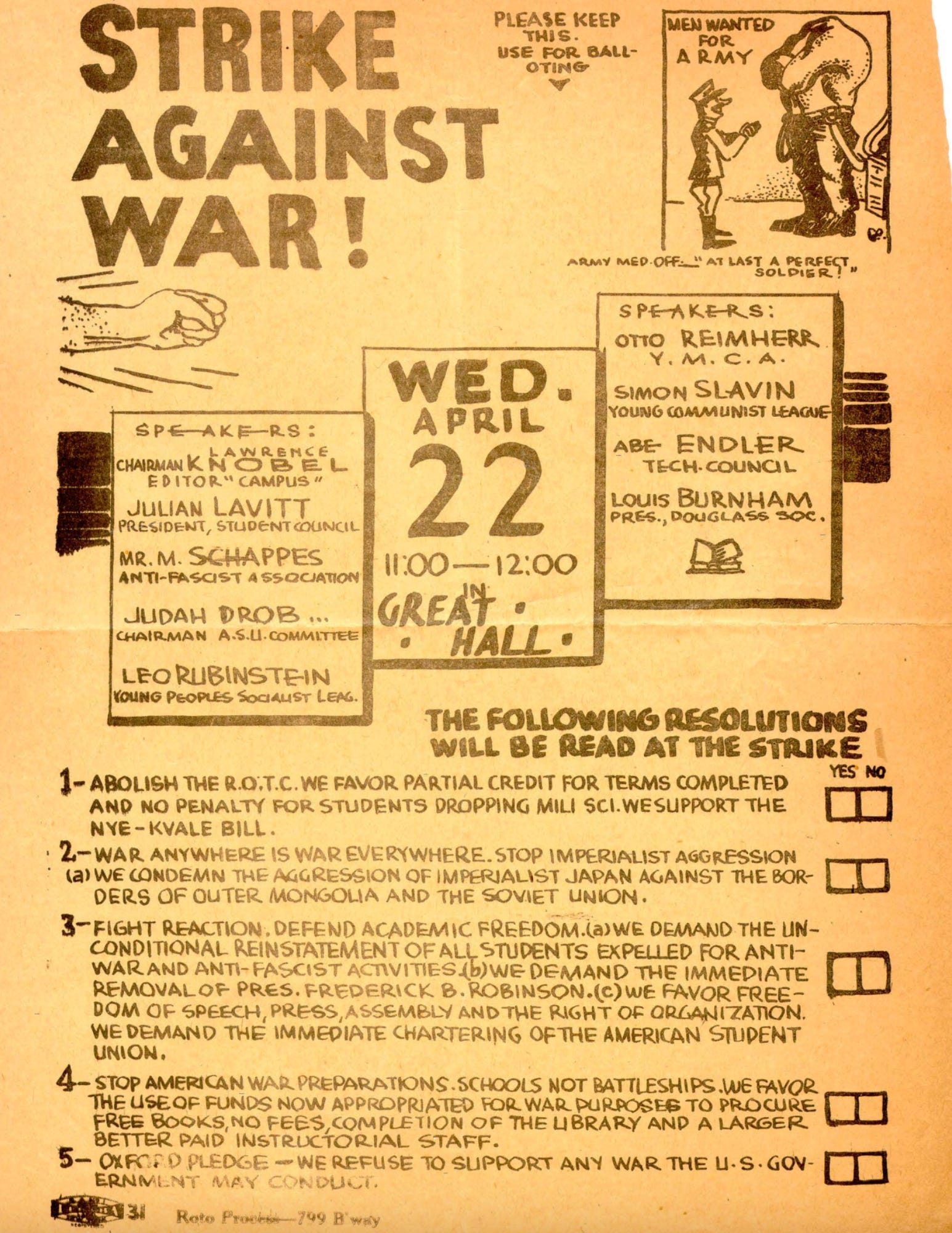
This flier advertises an April 22, 1936 anti-war demonstration in the Great Hall at the City College of New York (CCNY). The event, attended by 3,500 students, featured addresses from student and faculty leaders as well as a vote that reaffirmed the students’ fight against both the ROTC on campus and CCNY President Frederick Robinson.
This was the political atmosphere that would lead Congress to pass the first of many Neutrality Acts in 1935:
Adding to the disillusionment was the widespread idea that the defense industry and big banks pushed the US into WWI. The Special Committee on Investigation of the Munitions Industry led by Senator Gerald Nye (R-North Dakota) suggested that bankers and war profiteers were secretly pulling strings to generate massive profits.
There are obviously many parallels to the 2020s here. We once again have an American electorate suspicious of the value of foreign intervention at the exact time totalitarian nations are on the march in Europe and Asia.
Disappointment with the outcome of the wars in Afghanistan and Iraq, distrust of the defense industry, student anti-war movements, and a disillusioned younger generation are all features of our modern times.
These views have shaped Trump’s NSS, with direct echoes from the 1930s (brackets added by author):
“Our elites badly miscalculated America’s willingness to shoulder forever global burdens to which the American people saw no connection to the national interest [anti-intervention bias from the 30s]. They overestimated America’s ability to fund, simultaneously, a massive welfare regulatory-administrative state alongside a massive military, diplomatic, intelligence, and foreign aid complex [Nye Committee pessimism]. They placed hugely misguided and destructive bets on globalism and so-called “free trade” that hollowed out the very middle class and industrial base on which American economic and military preeminence depend [anti-free trade sentiment]. They allowed allies and partners to offload the cost of their defense onto the American people, and sometimes to suck us into conflicts and controversies central to their interests but peripheral or irrelevant to our own [disappointment with the WWI experience]. And they lashed American policy to a network of international institutions, some of which are driven by outright anti-Americanism and many by a transnationalism that explicitly seeks to dissolve individual state sovereignty [disappointment in the failure of the League of Nations].”
America First
The above sentiments inevitably lead to an America First stance. During the 1930s, the America First movement would grow into one of the largest anti-war movements in American history.
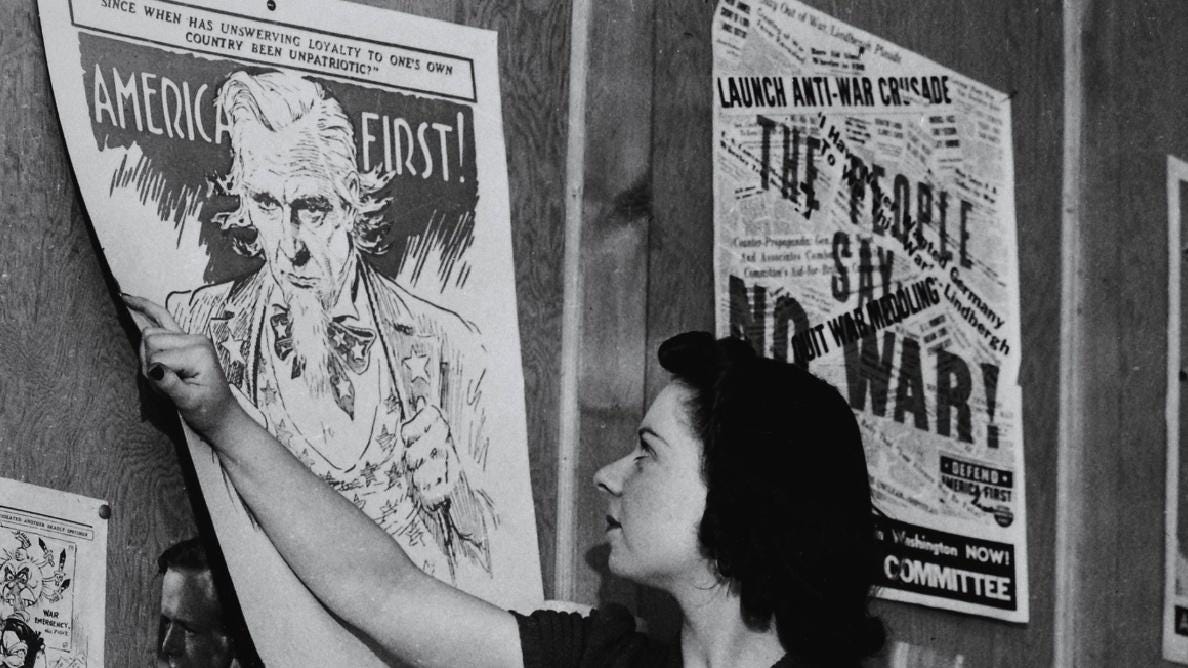
America First supporter in 1940
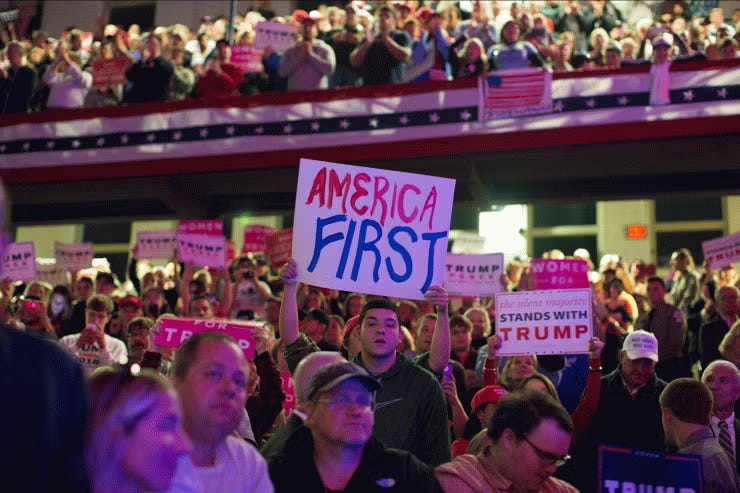
America First supporter at a 2024 Trump rally
The country, during the 1930s and today, has swung towards higher acceptance of isolationism. If political leaders can use this sentiment to consolidate American power as in the 1930s, it won’t count as wasted time.
Focus on the Western Hemisphere
During the 1930s, Franklin Delano Roosevelt faced many of the same headwinds as the Trump administration. FDR’s initial response, beyond focusing on New Deal policies to bring the country out of the Great Depression, was a focus on the Western Hemisphere.
FDR needed to shore up American diplomatic and trade relations to prepare for the coming storm. This imperative could be pursued first in the Western Hemisphere without risk of involvement in foreign wars.
At the same time, getting Western Hemisphere countries lined up behind US leadership would strengthen the US hand in negotiations with the British, French, Russians, and Chinese since the US lacked extensive colonial or overseas possessions.
FDR and Cordell Hull struck out on the Good Neighbor Policy across the Caribbean and Latin America. This included declaring non-intervention and non-interference in Latin American affairs, opening up cultural and transport links.
This policy would end the US Marine Corps’ occupation of Haiti and pull back American troops in the region. This would appease the isolationist America First faction in domestic US politics while allowing Washington to recoup a small measure of military capability and focus.
This has direct echoes with the Trump NSS and the ongoing operations in SOUTHCOM. FDR did not have to face down a Latin America with significant communist, Russian, and Chinese influence. Trump is seeking to address a bad neighbor problem in the region.
Foreign policy circles have for decades decried the lack of strategic prioritization from the White House. Well, now they got it, good and hard. And not in the way they expected. The NSS explicitly prioritizes the defense and consolidation of the Western Hemisphere.
Enlisting Allies
FDR would also take extraordinary measures to strengthen potential US allies in the coming war. The Roosevelt administration, with the assistance of Henry Morgenthau, implemented Cash and Carry and Lend-Lease policies to invigorate potential allied nations on the front lines of fascism.
In a direct parallel, the Trump NSS discusses the following topics:
“Second, the United States must work with our treaty allies and partners—who together add another $35 trillion in economic power to our own $30 trillion national economy (together constituting more than half the world economy)—to counteract predatory economic practices and use our combined economic power to help safeguard our prime position in the world economy and ensure that allied economies do not become subordinate to any competing power [...] A favorable conventional military balance remains an essential component of strategic competition. There is, rightly, much focus on Taiwan, partly because of Taiwan’s dominance of semiconductor production, but mostly because Taiwan provides direct access to the Second Island Chain and splits Northeast and Southeast Asia into two distinct theaters [...] We will build a military capable of denying aggression anywhere in the First Island Chain. But the American military cannot, and should not have to, do this alone. Our allies must step up and spend—and more importantly do—much more for collective defense [...] Our goal should be to help Europe correct its current trajectory. We will need a strong Europe to help us successfully compete, and to work in concert with us to prevent any adversary from dominating Europe.”
Rebuilding the Defense Industrial Base
FDR would also deal with a complicated global trade regime and a hollowed-out American industrial base due to the Great Depression. The Roosevelt administration would sign much legislation to correct these deficiencies, seeking to reduce trade barriers with allies and cooperative nations and to rebuild the industrial economy.
One key piece of legislation was the National Industrial Recovery Act of 1933, which created the National Recovery Agency (NRA). The NRA was deeply anti-competitive, and consolidated American industry, promoted price-fixing, and supported the growth of labor unions.
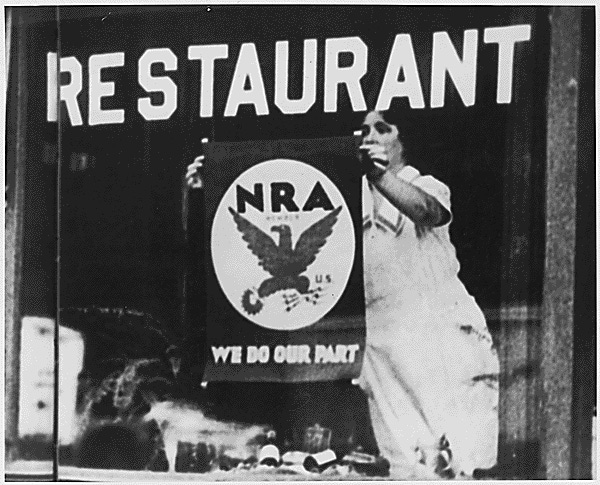
Supporter of FDR’s National Recovery Agency (NRA) hanging a poster in their business window
The goal of the legislation was to breathe new life into American industry. While FDR would reverse direction when promoting the Second New Deal policies of 1935, the goal remained the same.
We are once again in an era of government tinkering in the private economy to revitalize American industrial capacity. From the 2025 NSS:
“We want the world’s most robust industrial base. American national power depends on a strong industrial sector capable of meeting both peacetime and wartime production demands. That requires not only direct defense industrial production capacity but also defense-related production capacity. Cultivating American industrial strength must become the highest priority of national economic policy.”
How Russia and China Should View this Document
This is the final warning. While Moscow and Beijing should pay heed, they likely lack the wisdom to listen. Washington is entering a period of strategic consolidation and opportunity, rearmament, and strengthening allies.
Once consolidation has picked up pace and paid dividends, expansion and projection under another president, or even the same president, is inevitable.
Conclusion
While the strategy will be widely derided in left-leaning news outlets and international relations circles, ignore the partisan heat of the times.
This is a restrained, sensible, bipartisan strategy document that harkens back to successful American strategies of the past. It is remarkable how similar Washington’s current strategy is to the 1930s. This is an appropriate plan for a second-term president in his back three years, and will form an extremely durable foundation for the next president, regardless of party, to form his own strategic approach.
Vermilion would argue that this unclassified version of the document does not go nearly far enough in addressing the Chinese Communist Party as the central organizing threat of the century. But that may be an updated strategy for a future time.