
The Hormuz Tryst

The Iran conflict is still a side show to the larger global war slowly unfolding.
The earlier focus on the downed F-15E is notable in terms of US domestic partisan politics, but is yet again another sideshow. The US military shredded the regime’s air force, navy, and integrated air defense system in exchange for single digit aircraft losses (which will creep up) and about a dozen expendable drones on the American side.
Aircraft go down in combat, especially onces designed in 1969. The US has capabilities to retrieve pilots and destroy sensitive equipment - all working as normal.
The current focus on negotiations also misses the point that Tehran is either acting in bad faith or is sending negotiators with no authorization to sign a deal. Decision makers in Iran clearly believe that negotiations give the regime time to breath and a shot at crumbling the Trump administrations resolve. Washington should not let Tehran off so easily. It must be clear to Iranian decision makers what will happen if they fail to reach an agreement acceptable to the US.
If Tehran Cannot Agree to War Termination on US Terms
Exercise control of the Strait of Hormuz until such a time that the government in Tehran is able to work cooperatively with Washington to maintain the strait.
Employ conventional forces to seize Iran’s arch defense of islands, consisting of all or some combination of Kharg, Qeshm, Abu Masa, the Tunbs, Larak, Hormuz, Hengam, Lavan, Sirri, and Kish.
Occupy these islands at a future time during which they are defensible. Maintain these positions for defense of maritime shipping, US military access, and leverage over Tehran.
Continue eliminating Iranian leadership (especially in the IRGC) that chooses not to negotiate.
Continue eliminating elements of the Iranian nuclear program.
Surge SOF to assist civilians in overthrow of the totalitarian theocratic regime.
Continue to remove the Iranian regime’s governable space through a combination of strategic bombing campaigns and support to protestors forming their own government.
Publicize Moscow and Beijing’s support to Tehran so they all pay the reputational cost.
Counter Iranian propaganda in the US by exposing Tehran-regime linked accounts more aggressively. Expose links between these accounts and Russian/Chinese accounts and tools like Seed Dance.
If Tehran Can Agree to War Termination on US Terms
Significant financial assistance to the Iranian government and people.
Significant reconstruction aid, materials, and expertise.
Mutual defense reassurances conditioned on Iran’s future non-aggressive behavior.
Iran’s Options Have Played Out
The regime is out of gas. The strategic bombing campaign, combined with the blockade of the Strait of Hormuz, removes economic levers from Tehran’s hands. The country is still cut off from the global internet, incurring continued economic damage. Tehran will continue to murder protestors, further eroding domestic support.
With the Iranian navy gone, Tehran only has small attack boats (which are usually not even counted within a nation’s naval battle force) with which to control the strait. The IRGC has not pushed these assets into the Strait, because they know without air cover, the entire attack boat force will be ground into a pulp by drones and A-10s (many have already been destroyed). Instead, they make vague threats about employing their attack boats. Good luck.
There is a significant divide between Iran’s negotiating team (led by Parliament Speaker Mohammad Bagher Ghalibaf and Foreign Minister Abbas Araghchi) and the Iranian military leaders in the Islamic Revolutionary Guard Corps (IRGC). If Tehran’s leadership cannot even get on the same page and sign a binding ceasefire document, expect Iranian political will to fade rapidly.
Washington needs to freeze Tehran in this position and not let up the pressure. This will lead to a death spiral for the current regime and force the negotiators to the table. Absent unrelenting pressure, Washington allows time for Iranian extremist elements to launch a terrorist attack on the US domestically, which would cause escalation orders of magnitude beyond what the administration could control in the short term.
Sustainable Force Commitment Level
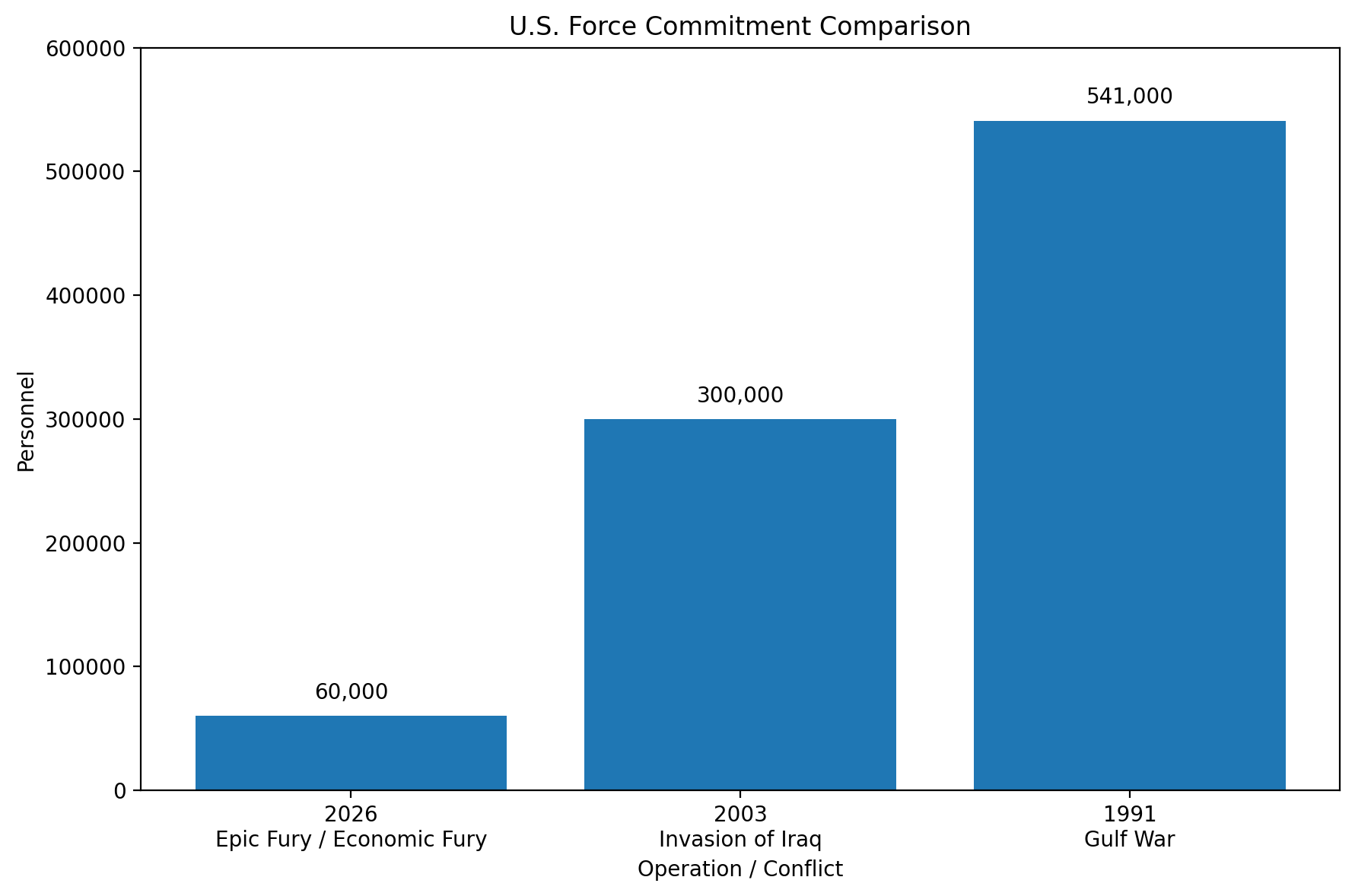
The current US forces supporting Operation Epic Fury / Economic Fury number around 60,000.
Three carrier strike groups (CSGs), two Marine Expeditionary Unit/Amphibious Readiness Groups (MEU/ARGs or perhaps expeditionary strike groups if additional cruisers/destroyers are attached), what appears to be elements of Destroyer Squadron 28 (DESRON 28), about 150 aircraft in theater, tanker and bomber air elements, air defense elements, submarines, and special forces.
To give some scope to these numbers, this is about the number of US personnel stationed in Japan. Not huge, not insignificant. But compare these numbers to the 2003 Invasion of Iraq and the 1991 Gulf War.
The 2003 initial invasion force numbered over 300,000 troops. This included six carrier battle groups (CVBGs), 15 air wings (a division-level air echelon), and multiple Army and Marine divisions. And let’s remember this was the middleweight force package for a relatively small war.
The 1991 initial invasion force (a heavyweight option for theater war) numbered around 541,000 US troops. This force was composed of six CVBGs, 807 in-theater USAF aircraft (which included six USAF fighter air wings and not including joint or allied airpower), and multiple ground corps, including seven Army divisions and two Marine divisions, plus allies.
The 2026 level of US force commitment is sustainable for Washington with little to no mobilization. Which is astonishing, considering the small size of today’s US military. While force levels are well within sustainable limits, magazine expenditure is of course a concern. However, nothing gets the government moving like an emergency on top of an emergency, so expect additional resources to flow into the US munitions plant.
Linkage to the Pacing Adversary - Triple Strait Control
US occupation of islands within the Strait of Hormuz will allow for military placement and access to directly control the waterway that delivers 10-20% of China’s imported oil.
While about 80% of the PRC’s imported oil and 20% of imported natural gas comes through the Strait of Malacca, the US has no direct control of Malacca outside of friendly relationships with Singapore, Malaysia, and Indonesia, as well as the use of a deployed military force.
At the onset of a US-PRC conflict, Malacca nations may vacillate, remain neutral, or even bandwagon with Beijing. These countries would likely not choose to choke off Beijing’s trade flows on their own.
However, if the US can control Hormuz today, this would significantly lower the chances of Malacca defections. If Washington can credibly communicate its intent to staunch PRC energy flows from their source, this gives far more wiggle room for Indo-Pacific nations to accede to a US blockade since PRC-bound maritime traffic will already be significantly reduced.
Controlling the Hormuz and Malacca straits will make controlling the Taiwan Strait easier if war comes to the Pacific.
A period of strategic opportunity has opened for Washington. To review from our previous post, Run the Board:
The US should immediately apply pressure to Nicaragua, Cuba, North Korea, Iran, Burma/Myanmar, and Cambodia in a sequential campaign to remove their authoritarian leaders and destroy the authoritarian global alliance network.
The severe degradation of this network will force the CCP General Secretary (Xi) to issue a new estimate of the 全局, or global situation, to the party. It will also likely force the CCP PLA Central Military Commission (CMC) Chairman (also Xi) to issue new Military Strategic Guidelines (MSGs) to the PLA.
The new 全局 and MSGs will force the PLA through a bureaucratic rework requiring 2-3 years to complete and erode China’s military focus and readiness at the same time their partner network implodes. Now is the time to stamp our foot on the gas.
Introducing the Vermilion App
Start your 7-day free trial at vermiliondashboard.com, on the Apple App Store, and now on the Google Play Store.
In a market full of apps built to trap you in a doomscroll, Vermilion is built to respect your time. It delivers high-value insight on China and national security in the least amount of time possible.
Designed for professionals in national security, diplomacy, intelligence, and business, Vermilion helps you enter your next briefing or meeting informed, current, and ready.
Be brief. Be right. Cut to the heart of the matter. Avoid trivia. Be gone.