
New Vermilion App + Article: Nuclear-Enabled Maneuver

Introducing the Vermilion App
In a market full of apps built to trap you in the scroll, Vermilion is built to respect your time. It delivers high-value insights on China and national security in the least time possible.
Designed for professionals in national security, diplomacy, intelligence, and business, Vermilion helps you enter your next briefing or meeting informed, current, and ready.
Start your 7-day free trial at vermiliondashboard.com or on the Apple App Store.
The app’s daily reports are written by the Vermilion Team, while pertinent news is continuously ingested and summarized by our AI agent for your perusal.
Be brief. Be right. Cut to the heart of the matter. Avoid trivia. Be gone.
Nuclear-Enabled Maneuver
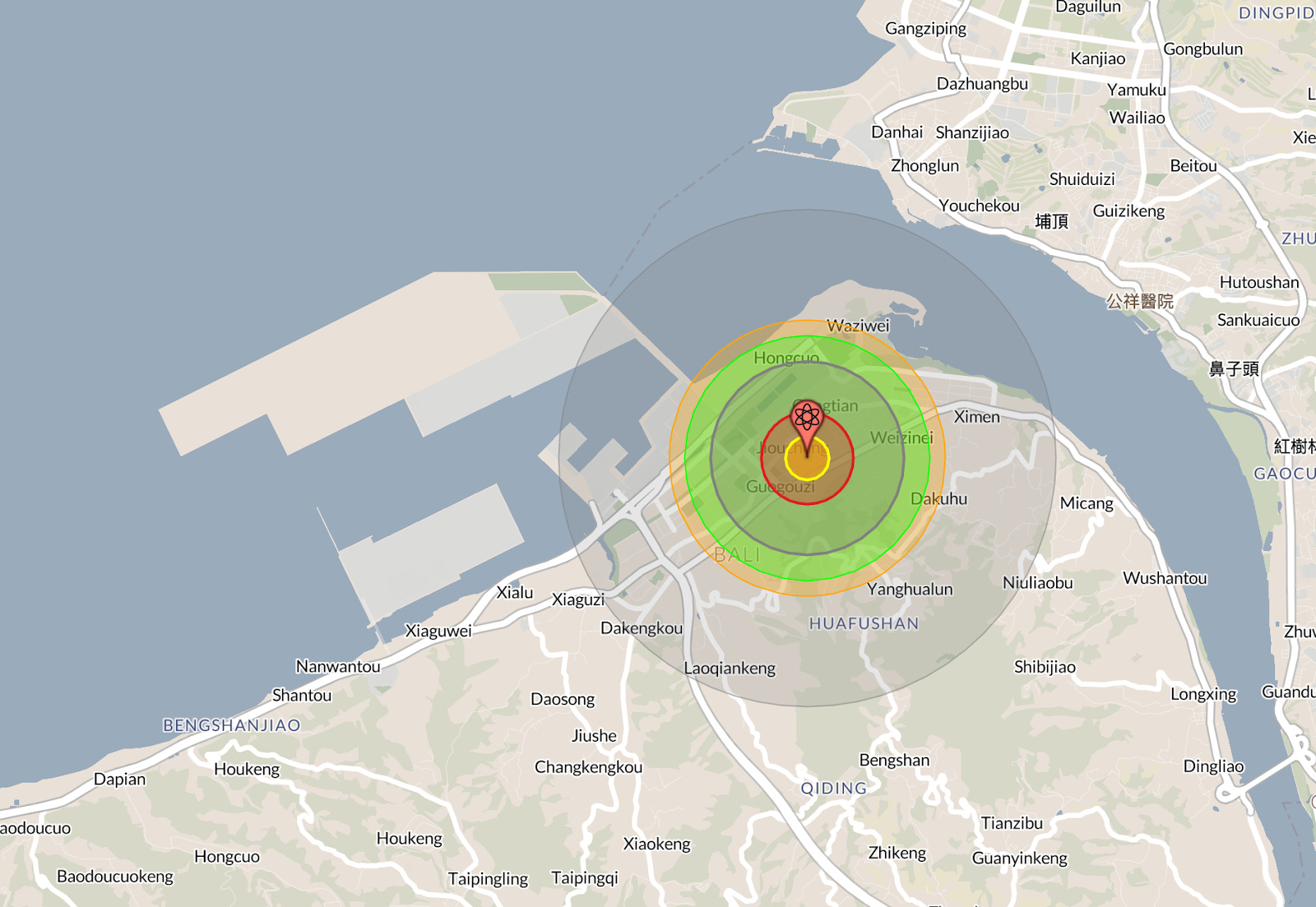
10 kiloton surface burst at Bali Beach
“I can reveal that the U.S. government is aware that China has conducted nuclear explosive tests, including preparing for tests with designated yields in the hundreds of tons,” U.S. Under Secretary of State for Arms Control and International Security Thomas DiNanno told a Disarmament Conference in Geneva.
The Chinese military “sought to conceal testing by obfuscating the nuclear explosions because it recognized these tests violate test ban commitments. China has used ‘decoupling’, a method to decrease the effectiveness of seismic monitoring, to hide their activities from the world,” he said. DiNanno said China had conducted one such “yield-producing test” on June 22, 2020.
There are a multitude of reasons why China is likely conducting nuclear tests. The People’s Liberation Army could be validating a new warhead design, improving the efficiency of an existing weapon, or signaling to the United States and other adversaries.
All of these are significant, not least because they represent a direct violation of test ban commitments the Chinese Communist Party publicly claims to uphold. Yet the “hundreds of tons” detail deserves particular attention because it may challenge a deeply held assumption about what nuclear weapons are and what they are for.
When many of us think about nuclear weapons, we think of the 15-kiloton Little Boy dropped over Hiroshima or Cold War tests like the 50-megaton Tsar Bomba detonated in Novaya Zemlya. These weapons were developed in vastly different contexts. Little Boy and Fat Man were meant to end the Second World War by destroying Japan’s will to fight, and Tsar Bomba was a form of nuclear coercive messaging.
The conventional wisdom in 2026 is that any employment of nuclear weapons is immediately a doomsday scenario. But conventional wisdom is rarely reality.
A Historic Precedent
During the Cold War, both the United States and Soviet Union trained to fight on nuclear-degraded battlefields where the employment of tactical nuclear artillery enabled ground troops to maneuver and seize objectives.
The ill-fated Pentomic Division, fielded in the late 1950s and ultimately abandoned in 1962, is an example of this. The Pentomic plan reorganized standard US Army divisions into five dispersed battle groups designed to survive and exploit tactical nuclear strikes on the battlefield. Offensive doctrine called for nuclear fires to blast through an enemy’s main defensive line, after which mobile ground forces would maneuver through the gap. The organizational structure failed, but the underlying assumption persisted for decades: low-yield nuclear weapons would be employed on the battlefield, and ground forces needed to be prepared to fight through the aftermath.
This was not unique to the United States.
Soviet tactical doctrine of the same era envisioned nuclear strikes as integral to offensive operations, replacing the massed conventional artillery fires of WWII with nuclear fires to destroy defensive positions and enable rapid armored exploitation. The yields of these Cold War-era systems, the Honest John for the US and the Luna for the Soviet Union, ranged from 2 to 30 kilotons.
These yields were well below the strategic weapons that often dominate our discussions today. China’s alleged test yield of hundreds of tons sits very much at the lower end of this tactical spectrum and could very well be employed in the same way that the Cold Warriors of yesteryear envisioned.
It is well known that the People’s Liberation Army faces what is potentially one of the most complicated military operations in human history. The challenges are plentiful: successful covert mobilization, crossing the strait without immense attrition, landing at designated sites, assaulting through hardened defensive positions against what will likely be a numerically superior force at first, establishing a lodgment, achieving a breakout, and then pushing towards Taipei to achieve victory. This does not even consider the actions required to keep Japan and the United States out of the fight.
PRC Nuclear Doctrine
If PLA forces suffered destruction in the strait, were repelled at the beaches, or were otherwise unable to break out from lodgment, the CCP could face its most dangerous moment. As risk to the PLA military operation rises, risk to the CCP’s hold on power also rises.
An abortive Taiwan campaign could destroy the CCP’s legitimacy. Under those conditions, PLA leadership might authorize limited tactical nuclear strikes to salvage the operation.
The stated policy of “No First Use” would not prevent this. NFU is a diplomatic tool, not necessarily an operational constraint. It operates within the same framework as “active defense,” in which the CCP alone decides what constitutes aggression against Chinese sovereignty and, therefore, what qualifies as a defensive response.
This is not speculation about a future departure from established behavior. It is the pattern. The CCP has engaged in these definitional gymnastics for its entire existence. The invasion of Tibet was a “peaceful liberation.” Entering the Korean War against United Nations forces was the “War to Resist US Aggression and Aid Korea.” The 1962 offensive into Indian territory was the “China-India Border Self-Defensive Counterattack.” The 1979 invasion of Vietnam, in which hundreds of thousands of PLA troops crossed an international border to punish Hanoi for deposing a Chinese client state in Cambodia, was the “Self-Defensive Counterattack Against Vietnam.”
Deng Xiaoping told the world that Vietnam was “a child that needs to be spanked” and then called the spanking self-defense. The seizure of South Vietnamese-held islands in the Paracels in 1974 and Vietnamese-held reefs in the Spratlys in 1988 followed the same line. In every case, the CCP determined that the other party had struck first, politically, strategically, morally, or imaginatively and that China was merely responding.
A Taiwan scenario would be no different. The CCP already considers the island a province in a state of rebellion. Any foreign military intervention to prevent unification would be framed as an act of aggression against Chinese sovereignty, the “first strike” to which nuclear employment would be a “defensive” response. And if the operation were to fail, if the regime that had staked its legitimacy on unification faced the prospect of a humiliating defeat broadcast to the world, the political conditions for authorizing tactical nuclear use would not require abandoning NFU. They would require only the same wordsmithing the CCP has exercised in every conflict it has ever fought.
Operational Vignette
The scenario that should concern US planners is not a bolt-from-the-blue nuclear strike. It is the moment when the PLA's cross-strait assault begins to founder.
Bali Beach sits on Taiwan’s northwest coast, less than seven miles from Taipei. Flanked by the Port of Taipei to the SW and the Tamsui River estuary to the E, it is a critical location. For this scenario, this area is designated “Red Beach”.
In this scenario, Eastern Theater Command is the main effort. Two amphibious combined arms brigades (ACABs) from the 73rd Group Army (GA), embarked from training areas in Fujian Province and launched across the strait aboard a mix of PLAN amphibious ships and requisitioned civilian RO-RO vessels, hitting the beach in the first wave.
Following a massive preparatory bombardment, 73rd GA ZBD-05 amphibious infantry fighting vehicles churn through the surf and crawl onto the gray sandy shoreline under fire.
The Taiwanese defenders are ready. Beach defense brigades have had weeks, possibly months, of strategic warning to occupy prepared positions in the low hills, parks, and urban areas behind the beach. They are dug in and armed with Javelin anti-tank missiles, Kestrel shoulder-fired rockets, light anti-armor weapons, and Stingers.
Overhead, Taiwanese drones are striking the PLA amphibious force as it transitions from sea to shore. Behind this defensive line, Taiwan’s M1A2T Abrams tanks are positioned in defilade along the roads leading inland, ready to counterattack any element that breaches the beach. Further back, HIMARS batteries are delivering precision rocket fire onto PLA assault lanes, turning the narrow landing zone into a killing field.
The 73rd Group Army is taking catastrophic losses. The two brigades have failed to secure the beachhead and cannot push inland. Follow-on forces are stacking up offshore and taking fire with nowhere to land.
Simultaneously, the airborne seizure of Taoyuan International Airport, the linchpin of the operation’s western flank, is in doubt. Elements of the PLA Air Force Airborne Corps dropped into the airport complex to seize the runways and establish an air bridge for follow-on forces, but surviving Taiwanese air defense units attrited PLAAF transport on approach.
Several Y-20s and Z-20s have been shot down and the airborne units that made it to the ground are fragmented and fighting without support. The PLA holds sections of the airport but cannot form a perimeter against Taiwanese army counterattacks supported by mechanized infantry. Without securing the airport, there is no air bridge. Without the air bridge, there is no reinforcement. Without reinforcement, PLA forces on the ground will be destroyed in detail.
Eastern Theater Command is now fighting for its life on two axes and losing on both. The lodgment at Bali Beach is a slaughter. The airborne objective is collapsing. The operational timeline, which depends on rapidly establishing a secure foothold, has been shattered.
Meanwhile, US forces are building up throughout Japan and cancelling training missions. Japanese Self-Defense Forces are mobilizing their southwestern island garrisons. The window for a fait accompli is rapidly closing.
At this moment, the PLA Rocket Force receives the order.
The Strike
The PLA Rocket Force has maintained a battery of DF-26 intermediate-range ballistic missiles (IRBMs) on heightened alert since the operation commenced. The warheads are low-yield, in the range of hundreds of tons, consistent with the yield the United States alleged China tested in June 2020.
The first strike hits Taiwanese defense positions just behind Bali Beach. A warhead in the range of 500 tons, detonated as a low airburst over assessed Taiwanese lines, produces a blast radius sufficient to destroy nearly everything within several hundred meters.
The overpressure shatters the fighting positions of both sides. Thermal radiation ignites everything flammable across the beach zone. The defenders who survive the initial blast are irradiated and unable to maintain a coherent defensive line. The Abrams tanks in defilade along the Tamsui river roads are outside the immediate kill radius, but their crews are flash-blinded and their communications are severed. For the first time since the landing began, the beach is quiet.
A second warhead detonates over the Taiwanese defenders south of Taoyuan International Airport. The mechanized infantry moving to counterattack the PLA Airborne are destroyed, and air defense units in the area are neutralized. The surviving PLA Airborne Corps elements at the airport are suddenly operating in a permissive environment. Within hours, the first Y-20 transports land unopposed and offload reinforcements. The air bridge is open.
The total expenditure is two tactical warheads. The combined yield is less than two kilotons, a fraction of what was dropped on Hiroshima. No warhead has struck Taipei directly. Most targets may have been military units in a combat zone on territory Beijing considers sovereign Chinese soil.
The CCP’s narrative machine is already framing the strikes as a regrettable but necessary defensive measure against foreign-armed separatists who threatened the lives of Chinese soldiers conducting a lawful “reunification” operation.
In the space of minutes, the operational picture has inverted. The Taiwanese beach defenders threatening the future of the CCP ceased to exist. The airfield seizure that was collapsing is now being reinforced. The 73rd Group Army’s follow-on echelons, stacked offshore with nowhere to land, are now moving toward a beach that is no longer a kill zone. The Eastern Theater Command has gone from losing the battle to winning it.
Aftermath
Breaching the nuclear threshold would, of course, open Pandora’s box, but this article will not explore the issues that arise the day after (which are many). Suffice to say, that when the Department of Defense/War has modeled out nuclear warfighting scenarios, even a small tactical employment eventually meanders into a general exchange.
But this may not be Beijing’s point of view. The Pentagon must be planning and preparing for PLA nuclear use not only against Taiwan, as in the scenario above, but against US forward positions in the Pacific.