
5Y Capital invests Chinese state capital into American Biotech
Get John on the phone

5Y Capital presents itself as one of China’s premier venture firms. In reality it is a vehicle that channels Chinese state funds into US biotech, while also investing US pension money into critical Chinese industries.
5Y Capital (五源资本), the Shanghai firm formerly known as Morningside Venture Capital, manages roughly $5 billion across hundreds of investments. Its limited partners include the investment arm of China’s State Council, the private equity arm of China’s sovereign wealth fund, a central state-owned conglomerate, and municipal capital platforms. What 5Y does not advertise is that it channels these funds into US biotechnology companies.
5Ys reach in the sector is strong and growing. 5Y invested in California and Massachusetts-based biotechs multiple times over the last three years, has multiple board seats, and is part of an ecosystem of Chinese state-affiliated investors moving into US biotech.
At the same time, 5Y is channeling American pension money into its China portfolio. This includes early investments into SenseTime and investments across China’s “little giants” (the companies the Ministry of Industry and Information Technology designates as underpinning PRC industrial policy - not good).
5Y is just another example of a Chinese fund manager using Chinese state capital to infiltrate critical US industries while using unwitting US pension funds to fuel China’s growth.
What We Know
PRC state-affiliated capital owns part of ReviR Therapeutics a US genetic-medicines company based out of Brisbane, California. 5Y partner Ted Jing is a ReviR board member and ReviR received a $4.6 million grant from CIRM, California’s taxpayer-funded stem cell agency. 5Y is just one of many Chinese firms that invested in ReviR.
5Y invested in LTZ Therapeutics, a Redwood City immunotherapy developer in May 2026. Its Series A was led by Lapam Capital, the same Beijing fund invested in ReviR.
In April 2026, 5Y co-led the $58 million Series A of Aureka Biotechnologies, a Laguna Hills AI drug-discovery company with operations in Shanghai.
5Y invested in Hopewell Therapeutics, a Woburn, Massachusetts developer of tissue-targeted lipid nanoparticles in May 2024.
5Y invested in Angitia Biopharmaceuticals, a Westlake Village developer of bone and muscle biologics running US clinical trials, in October 2021, January 2024, and January 2026.
5Y has a board seat at DeepCure, a Boston AI drug-discovery company.
5Y also invested in Apic Bio, a Cambridge, Massachusetts gene-therapy company.
Who Is Behind 5Y Capital
5Y’s founding partner is Richard Liu, a former engineer at state-owned Wuhan Iron and Steel who joined Morningside in 1999. He built its China venture business in 2008 with Ken Shi and the group rebranded to 5Y in 2020.
Morningside Group is the Newton, Massachusetts and Hong Kong investment office of the Chan family. The Chan family foundation gave $350 million to Harvard, renaming the school of public health, and later $175 million to UMass, renaming the medical school. At the same time, Gerald Chan (陈乐宗) was raising money from groups like Mayo Clinic and the Robert Wood Johnson Foundation to invest in China. The group traded large public donations for credibility and used this to raise American institutional money for its China funds.
What most accounts of the family’s philanthropy fail to mention is that Gerald’s brother and Morningside co-founder, Ronnie Chan, is affiliated with numerous united front organizations. He is part of the following:
Governor of the China-United States Exchange Foundation, the Hong Kong influence organization founded and chaired by Tung Chee-hwa, a former vice-chairman of the Chinese People’s Political Consultative Conference
Co-chairman of the Center for China and Globalization, a Beijing think tank tied to the Western Returned Scholars Association
Advisor to Tung’s Our Hong Kong Foundation (团结香港基金), a former executive committee chairman of the One Country Two Systems Research Institute
Former vice-chairman of the council of the China Development Research Foundation, PRC State Council’s Development Research Center
For legitimacy, Chan holds analogous roles in US organizations. He is Chair Emeritus of the Asia Society, chairman of its Hong Kong Center, and life trustee of the University of Southern California.
While peddling influence in both the US and China, Chan made his position clear. In October 2025 he told a Shanghai audience that the outcome of the US-China rivalry was already “game over,” implying that China had won.
5Y Capital’s Partners
Most of 5Y’s Chinese limited partners tie back to Beijing. The China Development Bank is owned by a wholly owned subsidiary of the State Council. CICC Jia Cheng is the direct-investment arm of CICC, a subsidiary of the sovereign wealth fund China Investment Corporation. China Merchants Group is a central state-owned enterprise supervised by SASAC.
On the US side, American pensions and foundations supply capital and credibility.
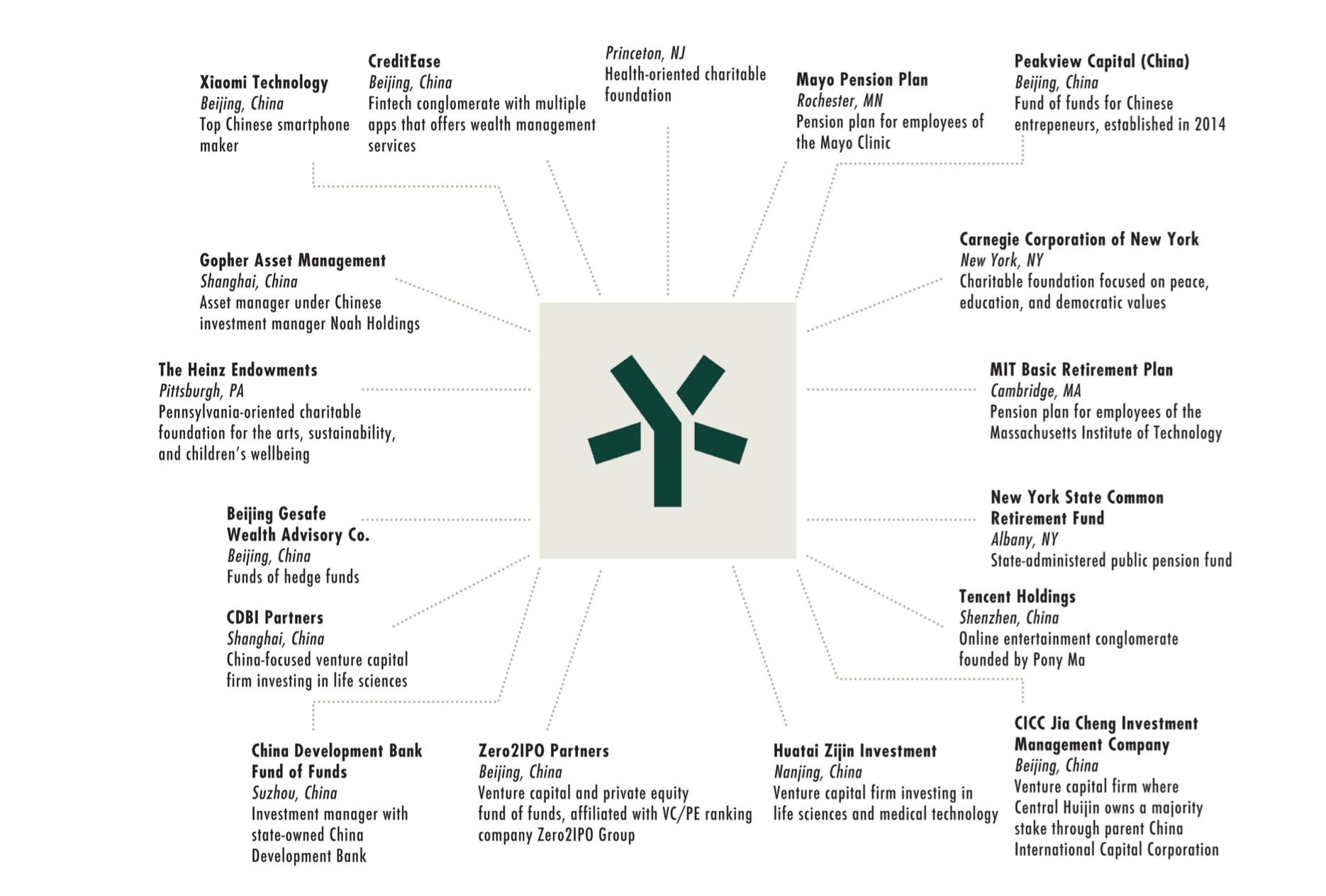
Where the American Money Went
US money is funding Beijing’s autarky. 5Y’s Chinese portfolio spans AI (Moonshot AI 月之暗面, StepFun 阶跃星辰), robotics (Hai Robotics 海柔创新, AgileX Robotics 松灵机器人, XYZ Robotics), chips (JaguarMicro 云豹智能, Gua Semiconductors, Silicon Integrated, Muye Microelectronics), quantum computing (Fuxi Quantum), satellites (Galaxy Space 银河航天), and autonomous driving (Pony.ai).
5Y has been doing this for years. Morningside China TMT Fund IV, the 2015 Cayman fund holding Mayo Clinic and Robert Wood Johnson Foundation commitments, invested in SenseTime (商汤科技) in 2017 and again in 2018. SenseTime was added to the Commerce Entity List in October 2019 for supplying surveillance technology used against the Uyghurs, barred to American investors by Treasury in December 2021, and appears on the Pentagon’s current Chinese military company list. The same LPs are invested in Horizon Robotics, which designs the chips that run China’s autonomous vehicles.
The examples above are historic. Moonshot AI is not. 5Y has backed the firm since its early rounds and invested as recently as January 2026. In July 2026 the White House accused Moonshot of distilling American frontier models and accessing export-controlled Nvidia hardware. US pension funds and foundations are funding this activity.
Back to 5Y Capital
Questions 5Y Capital and others need to answer:
Were ReviR’s American investors told about the LPs behind 5Y and other Chinese state-affiliated investors?
What percentage of ReviR does the fund hold today, what information rights are attached to Ted Jing’s board seat, and does ReviR hold genetic data of US persons within the meaning of CFIUS’s sensitive-personal-data rules?
Which 5Y vehicles hold the Apic Bio and DeepCure positions, and do any state-affiliated LPs reside within those vehicles?
Does US pension or foundation money touch any other little giants?
What To Do About It
CFIUS should use its non-notified transaction authority to review the ReviR investment and should treat minority biotech investments from PRC funds with state LPs as covered.
US pensions and endowments holding interests in China-focused funds that touch little giants should be forced to divest.
Sourced from Vermilion Data. This was written by a human with assistance from AI for structure and review.